Saturday, January 22, 2011

わたしの日本りょこう2011 part 3

 SHIRAHAMA-- Here's a great view of one of the pandas at Adventure World Zoo.  It was a pretty cold day, but nobody seemed to mind.  There were quite a few pandas I think about 8.  Also, new cubs, they were about 4 months old.  The two guys here on the swing are adolescent age, they played for a good hour straight, then took a bath and fell asleep.


えきちょうさん!
I know pandas are endangered and playing with a seal was a new experience, but my  favorite guy at the zoo was the dog Ekichyousan, the train station "boss".  Here's a video: パンダははなします!


Shirahama is also a big hot spring locale.  We stayed at a traditional style hotel.  Tatami mats, futons, hot spring baths, the whole deal.  For dinner the waitress served us in our room and later a two-man team hustled in to set up our futons for the night.  It was very well-coordinated and unique!  In the morning, we had "Viking-style" (buffet) breakfast in the dining hall.  Of course, I'm sure the view of the beach is much better in the summer, but sometimes I like a chilly, grey beach.
These reminded me of David Sedaris...


OSAKA--Our textbook wasn't kidding. Osaka is, in fact, a "lively city."  We spent only a half day here to visit my wife's friend Atsuko.  So far every city I've been to in Japan I liked way more than Tokyo, so if you any of you ever get to go to Japan,  try to check out the other cities!


くいだおれ、はじめまして。

Tsutenkaku.
The area around Tsutenkaku Tower especially had a little different feel to it though. Here it was more worn down, like a part of the city that's often overlooked.  Go ahead and compare the colors of the Tsutenkaku photo with my other Osaka photos.  We walked by a toy store and saw old dusty toys that my wife remembered from when she was a kid. I got excited when I saw an old Nintendo there still in its original packaging. But everything in the store had been yellowed and faded over the years.   I got a feeling if we ever go there again, that old Nintendo will still be there.  I learned later on a TV show that there's a bit of a homeless and crime problem here. 

Thursday, January 20, 2011

ふゆ休みに何をしました。

クリスマスにわたしとつまはおばさんとおじさんのうちへ行ました。おばさんとおじさんはロングアイランドにすんでいます。おばさんにUNBREAKABLEワイングラスをもらいました。すてきですね! そして、べんりです。アメリカンじんのりょうりをたべました。

それから、わたしの日本りょこうでした。わたしのしゃしんをみせてください。

Thursday, January 13, 2011

わたしの日本りょこう2011part 2


It was almost midnight and the beginning of the 2011, but the weather wasn't looking too good.  Even after our night at Newark International airport and an extra night at home waiting for a flight to Narita, the same lousy weather followed us all the way to Japan.  We were half way from Nagoya to Kyoto when the snow was just too much to drive in, so we decided to turn back.  We turned around at a toll booth where a friendly toll booth attendant helped me push the car out of the unplowed snow. Man, I wish I took a picture, hilarious stuff!  So instead of Kyoto, we pulled off at some smaller towns in the Gifu perfecture.
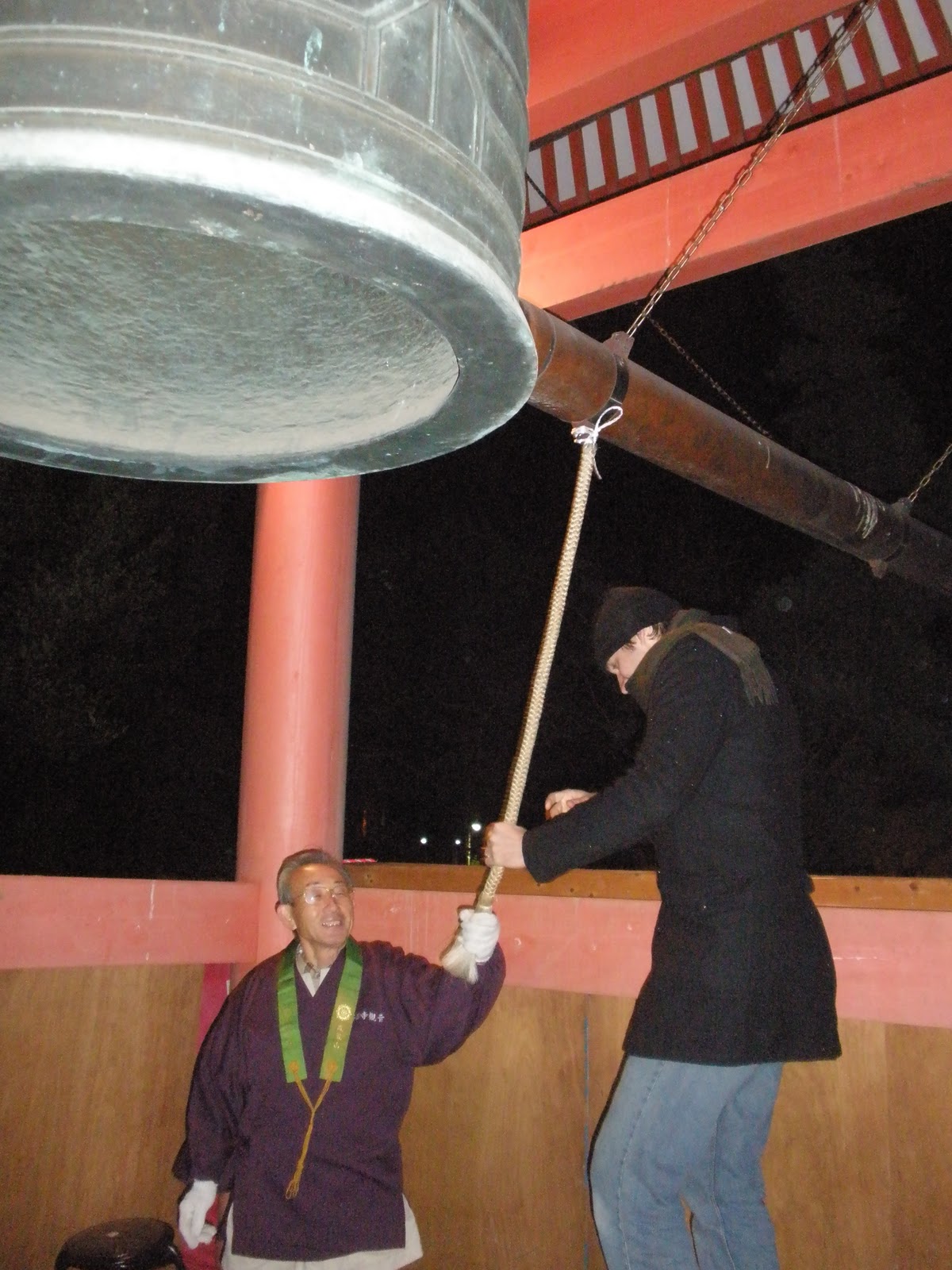
I will take New Year's Eve in Japan over New Year's in NY anytime.  Sure, both seem crowded, but I really like the traditions behind New Year's in Japan.  Here in Gifu, a  farming community, the celebration is devoted towards the Fox.  Since the fox comes and kills all the birds and what not that eat the rice crop.  To celebrate the fox, we fling fried tofu snacks for him along with our coins to the local shrine. Then we make our prayers for the New Year.
Fried Tofu
Candles!
Hittin' the Gong!

Gifu was a lot of fun.  Plus, I got a pretty good fortune this year.  In fact, me and ちち got the exact same fortune. Basically, we have to patient this year, and things will be okay.  Much better than my Kyoto '08 fortune, it was the worst possible one.  I had to tie it up and leave it behind.
Fortune time! No whammies!

In Gifu, every town we drove past seemed to have it's own bonfire New Year's celebration.  It was another farmer tradition to keep everyone aware of fires. Besides, it's January and we're all outside; we could use the heat!  I couldn't believe that the 6" of snow we were seeing 30 min. from Kyoto was nowhere to be seen here, but it was still cold and drizzly.  The big treat of the bonfire was sweet bean soup and warm sake.  Everyone was having a great time.  Even in smaller towns, in front of the temple a bonfire was lit and townspeople gathered around it.


The next day was the family trip to the graves.  Without sounding morbid, this is my favorite part of visiting Japan.  The graveyard is always beautiful, but I can't bring myself to photograph it.  The sky was high and blue, the whole scene was amazing.  Above is a picture of the bouquets and buckets that we buy.  After that we march to the grave with incense burning and then the family pitches in and cleans up the grave.  We weed, sweep, and splash water for our resting family.  It really is a unique moment.  Despite all the mayhem of "the holidays" and the travel and the buying of gifts, this is always the most calm and introspective time of the season.

That night we had Osechi, the New Year's food and massive amounts of Sukiyaki.  Osechi is an assortment of seafood and pickled veggies.  Each food has a little reason, or "an old dumb joke" (as my wife says) to go along with it, like: just as the prawn is bent over, may we live till we bend over with age like the prawn.  Then Sukiyaki, a beef and seafood stew.  This I like, since the beef reminds me of Philly Cheesesteaks.

Next is our trip to Osaka and Adventure World Zoo.

Monday, January 10, 2011

わたしの日本りょこう2011 part 1

Wow! I couldn't believe the snow.   Our flight was the morning after NY's big blizzard.  Getting to the airport was like straight out of "The Road," marching down city streets dragging our luggage.  Our flight was delayed 2 whole days, so we missed the family trip to the hot springs in Shirahama.  But we did make it to Japan in one piece and got to enjoy hot showers at Narita Airport.  Its a great deal, check it out next time you're there!
"One Piece" get it? "...in one piece..." Haha.

After our connecting flight to Nagoya. We stayed at the Trusty Hotel.  I liked their name and New Year's decoration.


Here's the standard subway ticket station.  Looks complicated, but works a lot like Washington DC's if you've ever been there.  My first time in Japan, I didn't know ANY Japanese.  Honestly, this was the most intimidating factor.  "What if I get lost?" I thought.  But now, after my first semester, I'm much more at ease and ready explore Japan.  What's interesting about the subway is how everybody lines up in designated lines before boarding the train.  Here's the subway instruction on discounts for kids.  I like how the kids look like they're having a great time with hands in the air.
I'm a huge fan of Japanese vending machines and the canned coffee, so it was great to see gai-jin brother Tommy Lee Jones.  At this particular machine you can even get warm corn chowder or sweet bean soup. I also like Nagoya's Manhole covers.
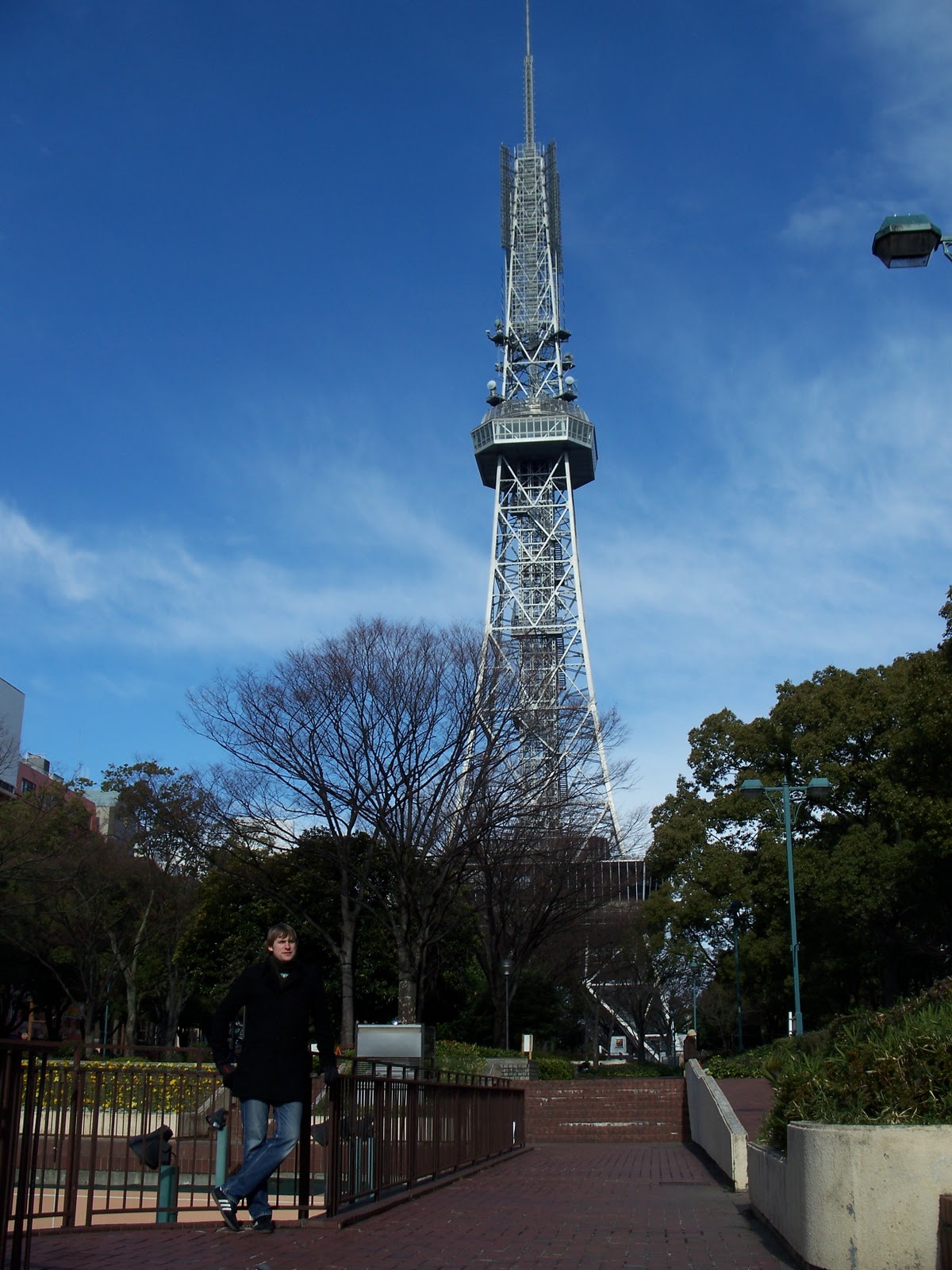
Never mind soda machines and man hole covers though, this is Nagoya's biggest landmark. Nagoya TV Tower in it's Central Park.


Here's some photos of Nagoya from 300 ft. up inside the tower.  How about that Shinto shrine and gate on top of a building?  I also liked the giant above ground pond.  We didn't get to go to Nagoya Castle but here's a picture from inside the Tower.  Can you see it? It's right in the middle:


This is only a small part of our trip. Stay tuned for more!

Thursday, December 9, 2010

百ねんご

みなさんのさくぶん3はとてもいいです! みなさんがんばて。
Never in a hundred years did I think I'd be in such a great class.  Everyone is so bright and and hard working; more importantly, I can't believe how patient and humble you all were throughout the semester, especially anyone who got stuck with me as a partner!  Another class I had this semester was all general studies students like me and those guys drove me crazy, but you were all very helpful and good-hearted.  Wish you all the best on the final.  Hope to see you next semester.

ウィスコンシンから、

それから 海軍、

日本せいかつまで、


I'll be visiting つまのかぞく during New Year's IN JAPAN.  This will be my second time visiting there.    Because of this class I'm just as excited to go as last time.  I'll remember you all in my 日本の願い。Maybe I'll keep up on my blog with pictures of the trip.  This semester wasn't easy, and Japanese may not get easy for a while, but it's a great and rewarding challenge for us all.

Tuesday, December 7, 2010

Compostion 3: 二十年ご

二十年ごわたしとつまはげんきでいます。わたしたちはおおきまちからきましたが、いましずかなせいかつをおくっています。うみのちかくのちさいうちにすんでいますから。だいたいまいにちつまといっしょにおよぎます。ふとんでねます。つまはこどものほんをかきます。そして、わたしはうみのけんきゅうしゃです。いまのせいかつはたのしいです。

Wednesday, December 1, 2010

カタカナ Analysis

Ever since I was a kid, I always took some feedback when I decided to chew my popsicle rather than suck and lick one into a sticky, soupy mess.  Call me impatient, but I always thought it tasted better when I bit right in.  So when I was introduced to the Japanese popsicle that had to be to be chewed to be appreciated, I couldn't have been happier.  The soda flavored popsicle called Gari-Gari Kun, is named for the onomatopoeic crunch that you hear and feel in you jaw when chewed.  This had been my introduction to the world of Japanese onomatopoeia, most interesting was how different "gari-gari" was from English versions of similar sound.  As far as chewing sounds are English has: crunch, chomp, munch, gnaw; not many more.  Additionally,  English crunch-type onomatopoeias have other uses and applications.  A 'crunch' could come from many things besides chewing, whereas Japanese words are much more unique in a sense.  Because of the unique nature of onomatopoeia, the Japanese writing system utilizes the katakana syllabary for their use in printed materials.

 I had also come across katakana with the word ザトウクジラ, Humpback Whale, in an Alaska tour book for Japanese.  But why had this katakana word (Zato Uku-jira) been used instead of a Japanese kanji spelling such as 座頭鯨?  On the same page, the humpback's brother whale, the Beluga, had been printed in Katakana as well ベルーガ (Berooga).  What's important to know about katakana is that it has several uses and an extensive history.

Katakana was developed during Japan's Heian Period (794-1185 AD).  In this time, katakana had come into use as an alphabet of phonograms, or sound based characters, based on Japanese Kanji (ideograms based on Chinese) characters.  Monks had used the new syllabary as a form of shorthand in the transcribing of sacred texts.  Around the same time the hiragana syllabary had been established for noble women to "express Japanese mentality" in diaries and poems (Nakagawa).  In addition, some musical scores from this time are also written in katakana (mnsu.edu).  Much later, after Japan's Meiji Revolution in 1868, the use of Katakana had been established for functional words and hiragana established as a means to express foreign or "loan" words from the west (Nakagawa). 

World War II, marked another cornerstone in establishing modern Japanese wrinting.  During the war with Japanese nationalism, many previous loanwords had been given Japanese names.  By the war's end,  loanwords had returned and it had been ruled that Katakana would be used for them.  Today, katakana is used for three reasons: onomatopoeia, loan words, and emphasis words.  

Because of its distinct, sweeping strokes and edges, katakana also serves as an emphasis in printed words, much like how Latin based alphabets use italics.  An example of a katakana emphasis would be in company names.  Despite the fact that most business names derive from the family name such as Toyota, or Asahi it is customary to see the name in katakana versus Kanji.  Printed emphasis may be seen in works of art such as poetry or manga, to attach more meaning or emphasis to particular words.

Because of Japan's dynamic history, in particular the 19th and 20th centuries have allowed the opportunity for many changes in the Japanese writing system.  It is interesting and a challenge to trace its history.  Above all, the written language of Japan is vital to the Japanese culture. Despite its origins from China, Japanese stands alone in its style and grace; unique from any other language.


References:
Anonymous.  "Heinan Period (794-1185 AD)."  Minnesota State University eMuseum.  Web.  30 November 2010.

Nakagawa, Hiroshi.  "Web Based Acquisition of Japanese Katakana Variants."  Tokyo University: Powerpoint Presentation.  2005. Web. 30 November 2010.