Hakodate, Hokkaido--There's a TV show me and my wife like, called Moya-moya Saamazu (Hazy Summers). It's not a sitcom or anything, each episode covers a different city with these three people who just walk around, weaving through all the back alleys of Japan, looking for unique little places or they'll skirt around the larger tourist attractions and give a more down-to-earth look at a place. The show has a real laid-back feel to it and really dispels any notion of Japanese stoicism or what-have-you.
So, when I got to Hakodate, despite the initial lack of compassion from my new home and the tough time in school, I knew I'd have to hit the streets and find things on my own. By the end of my stay, on foot I covered almost the whole town seen below.
My favorite part was taking the long way home from school by walking along the beach. Fishing and, in particular, squid fishing are the city's big industry. Which is one thing I liked about the city. It's very scenic, beautiful in some places, and the city has a lot of history, so tourism is pretty popular, but the blue-collar aesthetic is definitely present and this gives Hakodate a leaner edge to it.


But like the US, this working-class, "rugged individualism" often gives way to more conservative politics and establishes heteronormativity, even on the domestic, at-home front. I didn't want to let all this stuff get to me though. I just wanted to make it through the program. Just learn Japanese. Would it be possible for me to enjoy myself though? What was it going to take? I had to get in, so to speak, and experience things the way the folks on Moyamoya Saamazu would, that is: without bringing in stereotypes or politics or whatever else betrays mutual respect and good ol' fashion friendliness. I couldn't function until I found someplace where "our troubles were all the same," so I walked around.
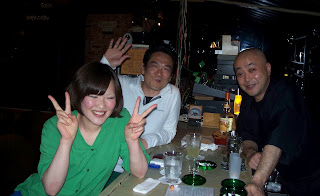
One of the first places that caught my attention was a place downtown, a bar called White Beatles. I first noticed it on my bus ride in from the airport. The night before orientation and before the program began, I stole away from the school crowd and got the chance to check it out for myself. Inside, it was just me and the owner/bartender, Abe-san with his fantastic setup for a rock band, more impressive than even my Uncle Paul's attic. After awhile, friends of his showed up, a cackling group of middle-aged guys, who could really play. They took their music seriously, knowing all the music and lyrics to American classic rock much better than I ever could. Over the course of my two months here, I'd be back to visit four more times. Every time I came, different musicians would come in, Abe-san would work with anyone from J-Pop kids trying to figure out their guitars to older, jazz musicians who came in with entire entourages. It had a great atmosphere, it was friendly and no pressure or weird uncomfortable feelings. My last night in Hakodate, Abe-san even invited me up to sing "Stand by Me."


Once school started, I was overwhelmed by the curriculum and the "Japanese language only" rule. My ability with the language felt hopeless. I felt like I was going to be forever behind, like there was some force that was watching me. Anytime I tried to speak in Japanese I felt like I was being quizzed. This really held me back and made me uncomfortable with the language despite having studied it for over a year by now. So I kept trying to get away from the school setting, this included my host-family whom I felt in cahoots with the school, and seek-out people that would respect an attempt to communicate and understand.


The first friday afternoon I had, I walked even farther and ended up in the center of the city, near Goryokaku Park. I saw a small building on the shabby side, but what caught my attention were all the nuclear protest signs that had been put up in the windows. I stopped to read them and then noticed a couple of dudes waving me to come in. The door was open. It was a cool afternoon. I thought about my friend Evan from the Navy, the way he'd jump on any chance to meet new people while we were in a foreign port and take me along for the ride. So I went in.
I met Hachi-san and his friend Kenji from Okinawa. They were both surfers, about my age, who were big into protesting Japan's nuclear power. I wasn't exactly sure where I was, but ended up having a really good time. Hachi-san whipped us up pizza bread for a snack, made with real Hokkaido Jingis Khan sauce. Here too, over the course of my stay, I'd come back to hang out with my new pals. Naturally, I found it easier to use the language than I did while in school or at home. People were more patient in places like this and I didn't have the feeling of being analyzed and graded every step of the way. I really needed this.

Whoa now! There was still work to be done at school. From the beginning we had been tasked with developing our own sort of research project. I wanted to use the opportunity to get out and away from the academic setting of the school, maybe get off land altogether. I had known about the importance of the city's squid fishing industry. How late at night, boats decked out with strings of bright, halogen lamps would go out and troll for squid lured in by the light. I really wanted an excuse to get on one these boats. And I had done so much comparing my tribulations here in Hakodate with my first years of being on a submarine, that I felt there had to be a connection. Would being on the water absolve any of this?


In the end, the school really hooked me up. They got me in touch with people in the business. While I wasn't able to take a late night cruise aboard a brilliant big-game squid boat, the school introduced me to a hobby squid-fisherman named Sakino-san. He took me out for a trip about five miles behind Mt. Hakodate, and showed me a part of the land I'd never see otherwise. We dropped anchor and spent the afternoon fishing with deep-water reels. He trusted me with his gear, even let me pilot his boat and gave me almost everything I needed for my school-project.
The little trip brought about some feelings that I haven't felt since my last underway. Simple things like keeping an eye on a gage-reading while performing some other task, keeping one's footing in-doing so. Then the tension of having to visually scan through the fog in anticipation for another contact. Watching a radar screen, watching own-ship's head. That feeling of your own sweat and the salty air mixing together. Man! And finally the return-to-port, standing on the side of the boat as we near the pier, ready to spring into action and moor. There is always this urgency to do so as fast as possible. To me this wasn't really for the excitement of getting off the boat, I hated return-to-port sometimes, but instead it was just about taking charge of the boat and showing the ability to handle it... the real question was could I handle the rest of my time in Hakodate?
 |
| Encrusted with barnacles. Seychelles, 2009. That's me on the right. |


